Description
5-axis CNC machining centre for aluminium
The FCN-A is the 5-axis CNC machining centre in the FCN range designed for high-speed machining of aluminium, titanium, composites and resins. It is a reinforced model fitted with linear encoders that puts rigidity and precision first in the most demanding jobs.
Ideal for model production and part trimming, it meets the needs of the marine, aeronautical and aerospace, railway, automotive and wind energy sectors. Its overhead guidance concept and modular structure make it an effective alternative for large parts, as it uses the space within its span as working area.
Applications of the FCN-A milling machine
Aluminium and composite machining for transport, energy and tooling
The FCN-A is designed for industries where a tenth of a millimetre either way separates an accepted part from a reject. Its five axes and slotted vacuum table allow it to handle both the machining of technical parts and the trimming of large components:
Marine: hull milling, manufacture of marine furniture and pontoons, and machining of structural parts.
Aeronautics and aerospace: manufacture of composites from different materials and of aluminium parts with complex geometries.
Railway: manufacture of aluminium profiles and trimming of interior furniture for coaches and wagons.
Automotive: manufacture of moulds and high-precision parts for limited series or exclusive designs.
Wind energy, moulds and models: moulds and models in aluminium, resin or composites that require precise profiles.
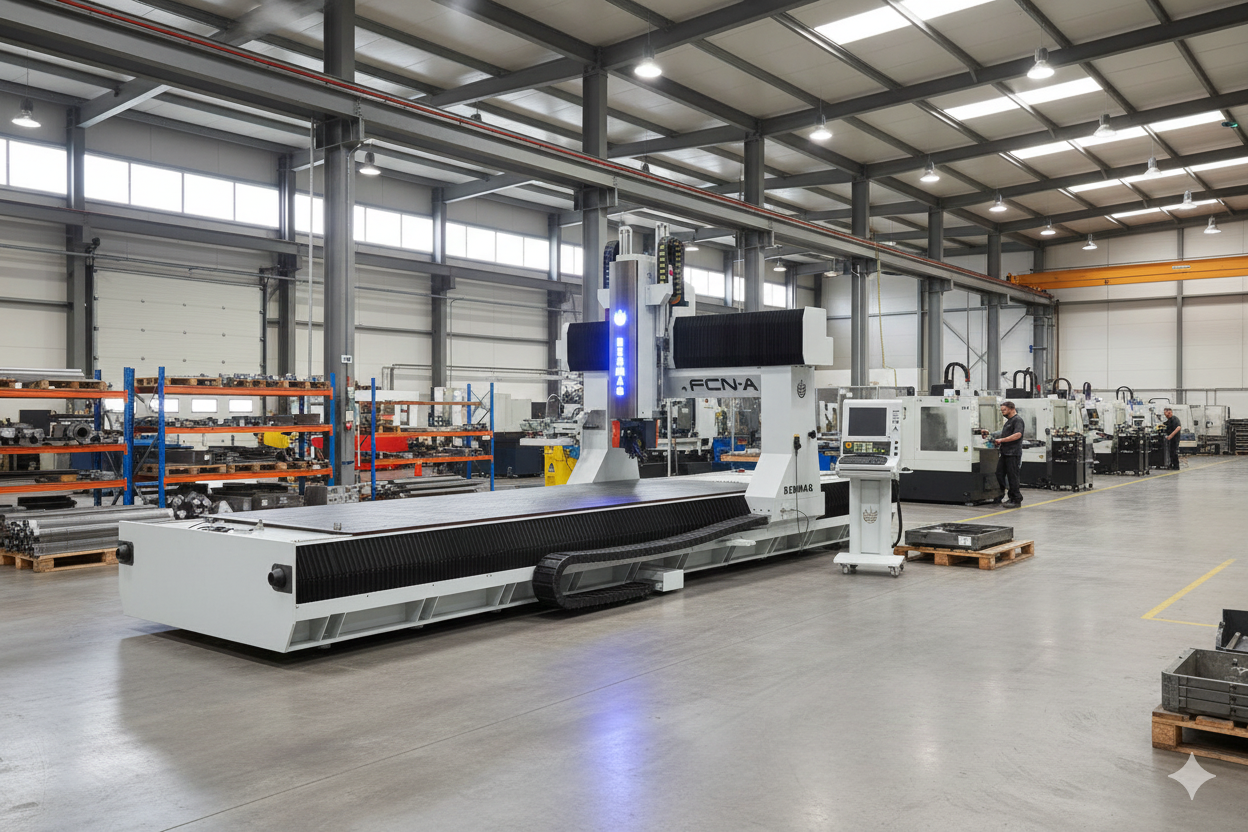
FCN-A milling machine technology for non-ferrous metals
Spindle of up to 24 kW with five interpolated axes
The milling motor delivers up to 24 kW, with a nominal speed of 10,000 rpm and a maximum of 24,000 rpm: power for roughing aluminium and speed for finishing. The rotary A (±110°) and C (±220°) axes turn at 135°/s, allowing the part to be machined from virtually any angle.
Linear encoders for ±0.015 mm repeatability
The FCN-A is the reinforced model in the range and comes with linear encoders as standard. The result is a precision of ±0.025 mm and a repeatability of ±0.015 mm, values that ensure tight tolerances on aluminium and composite components.
Cooling and lubrication designed for aluminium
VIP4TOOLS air-oil mist cooling unit, tool lubrication with cutting fluid, extraction system and automatic lubrication. Together they control the temperature in the cutting zone, make chip evacuation easier and protect the tool’s cutting edge.
Tool change on a 12 to 16-position turret
The automatic tool changer chains roughing, finishing, drilling and contouring without operator intervention. The machine runs on SIEMENS, HEIDENHAIN or FANUC numerical control, and the air-conditioned electrical cabinet protects the electronics during continuous operation.
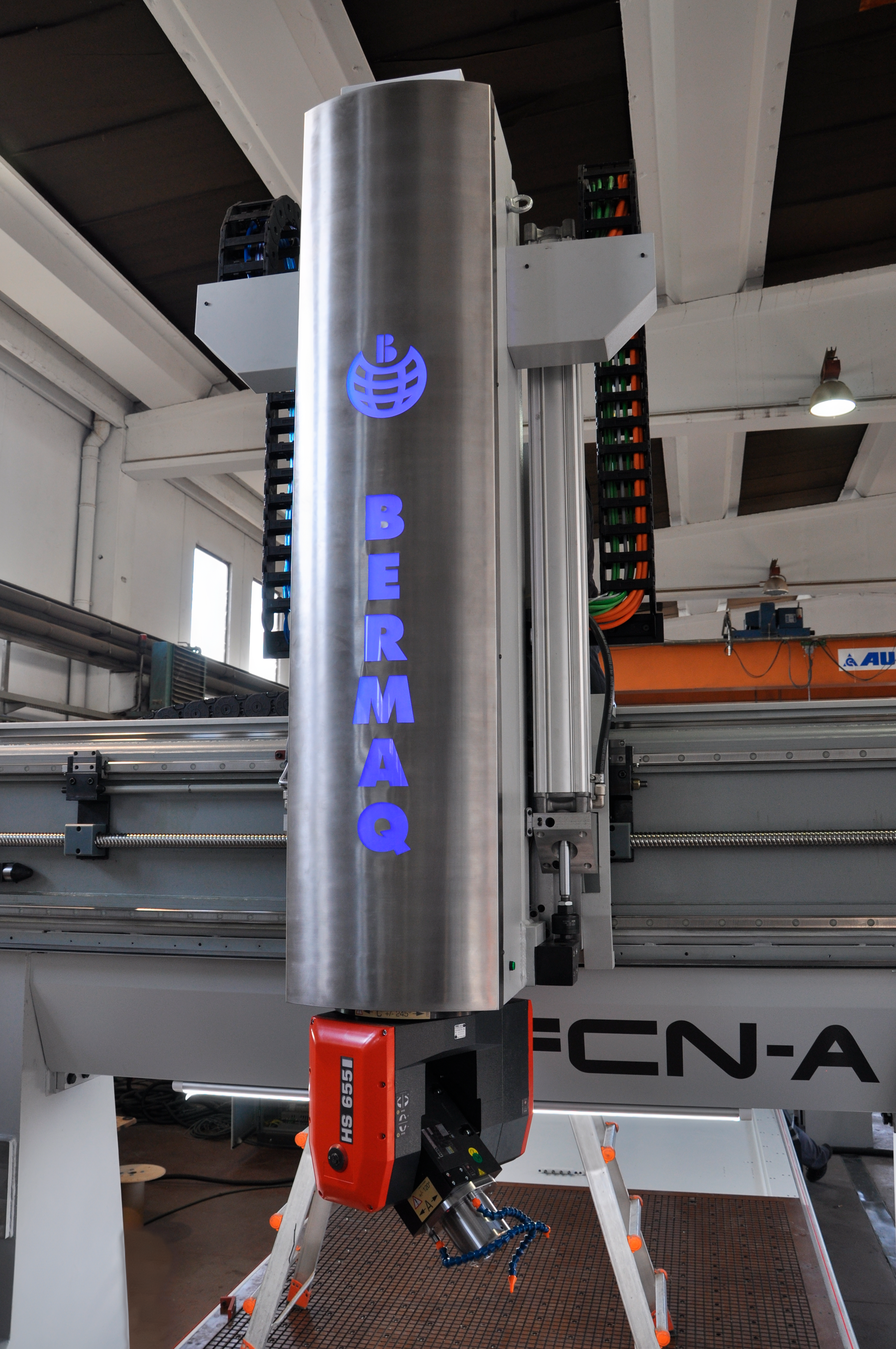
Structural design of the FCN-A milling machine
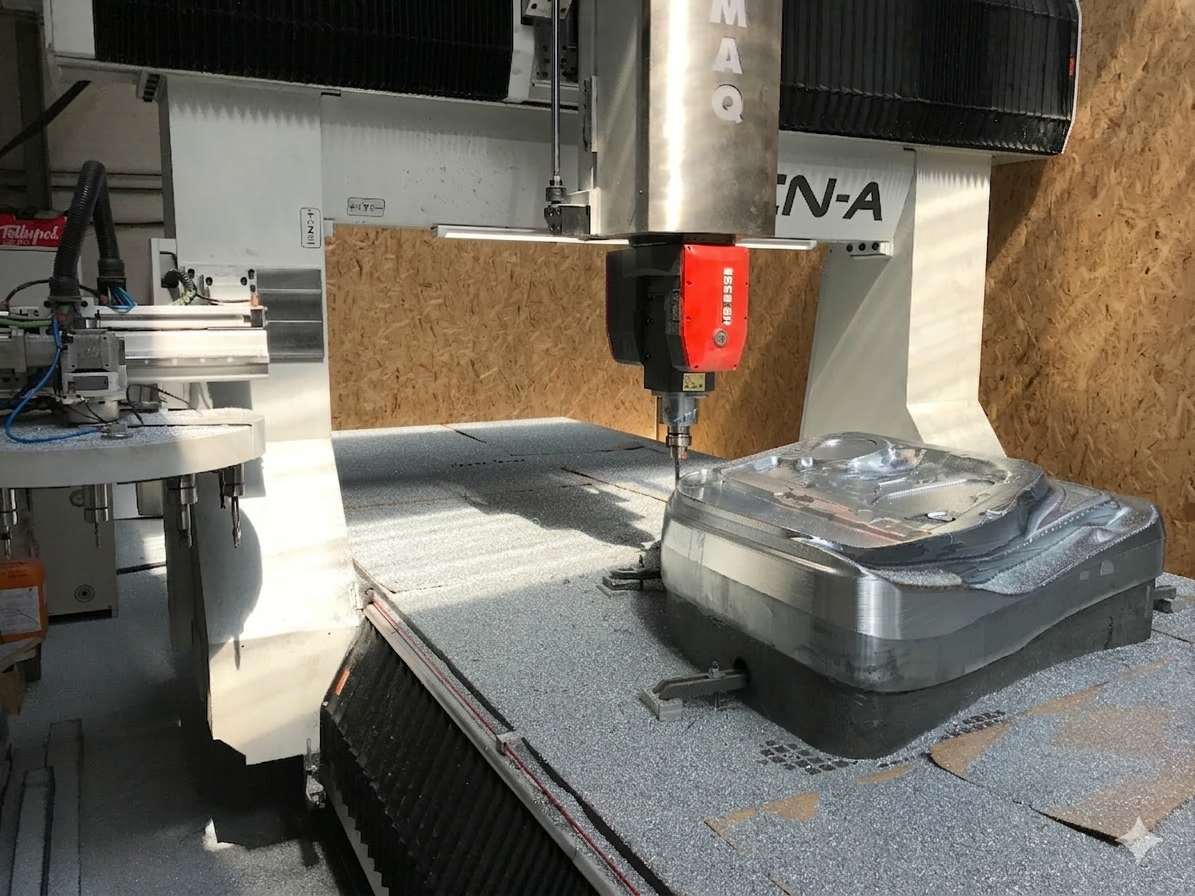
Overhead guidance and modular structure for large parts
Thanks to its overhead guidance concept, the FCN-A uses the space within its span as working area. It is available with working lengths of 2,000, 4,000 or 6,000 mm, a width of up to 3,000 mm and 800 mm of Z height, with travel speeds of 40 m/min in X and Y.
Slotted vacuum table with vacuum or vice clamping
The phenolic resin vacuum table, supplied by a 290 m³/h pump, allows the part to be held by vacuum or with a vice, so the same machine can process sheets, blocks and irregularly shaped parts.
Precision verified to ISO 230-2
Before delivery, BERMAQ checks the geometry with a FARO laser tracker and a Renishaw Ballbar interferometer and verifies axis positioning and repeatability in accordance with ISO 230-2:2014.
Extend the capabilities of the FCN-A
On-machine measurement and protection for critical processes
Pneumatic brake on the A and C axes: keeps the head locked during operations with a fixed orientation.
Pressurised precision measuring scales: protect the measuring system against chips and particles.
HEIDENHAIN TS460 or RENISHAW RMP60 touch probe: references the part and checks dimensions without unclamping it.
RENISHAW NC4 laser tool setter: measures the tool without contact to compensate for wear.
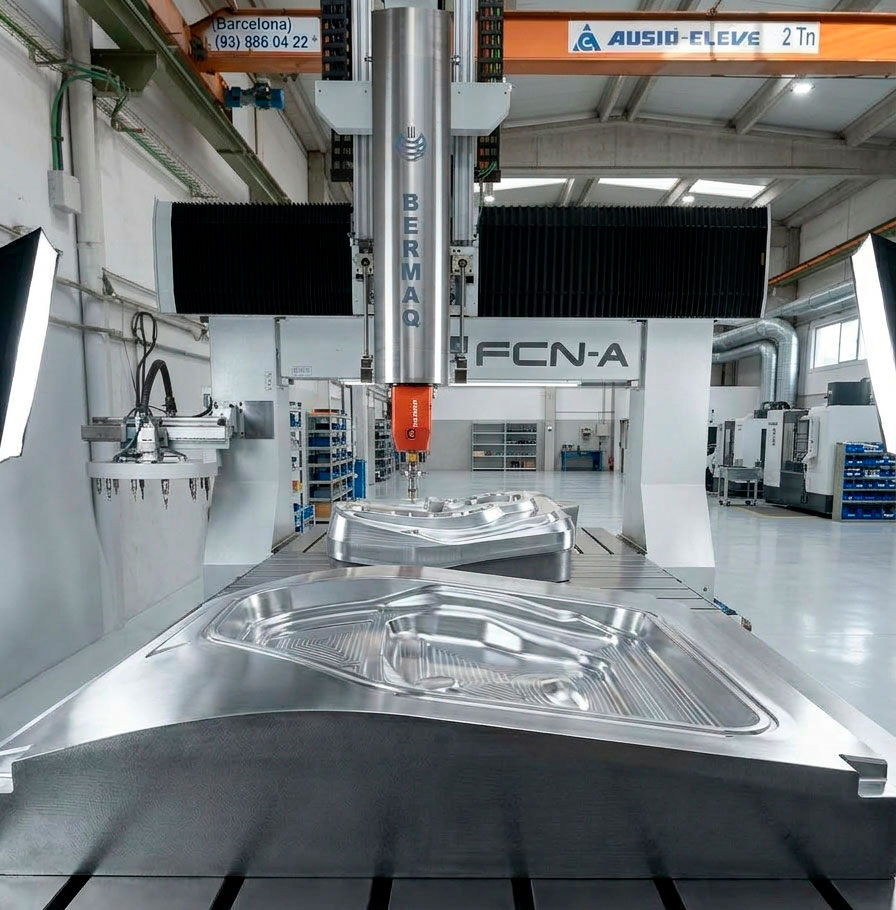
Ask for budget
Materials compatible with the FCN-A milling machine
Non-ferrous metals and high-performance technical materials
The combination of rigidity, spindle power and dedicated cooling systems allows the FCN-A to reliably process the materials used in the transport and energy industries:
Aluminium: profiles, plates, structural parts and moulds with fast roughing and a high-quality surface finish.
Titanium: technical parts that call for a rigid machine and precise control of cutting temperature.
Composites: carbon fibre and glass fibre for trimming aeronautical and marine components.
Resins: models and moulds for automotive, wind energy and tooling.
FCN-A versus FCN: the reinforced model in the range
The standard FCN focuses on large format and dynamics, with up to 20 kW, 60 m/min in X and Y and a precision of ±0.053 mm. The FCN-A, by contrast, is designed for metal: it adds linear encoders, raises power to 24 kW and improves precision to ±0.025 mm, with 40 m/min dynamics matched to the rigidity that aluminium demands. Both share a repeatability of ±0.015 mm and SIEMENS, HEIDENHAIN or FANUC control.
What the FCN-A brings to a machining plant
Five interpolated axes reduce the number of set-ups per part, and every set-up removed is a positioning error that disappears. Roughing and finishing are carried out on the same machine, on-machine probing shortens preparation, and the slotted table accepts everything from sheets to blocks. For aeronautical, marine, railway or mould shops, the outcome is fewer rejects, shorter cycles and repeatable quality.
BERMAQ manufacturing and technical support
The FCN-A is designed and manufactured entirely in Spain with EU components. BERMAQ supports each project from pre-sales advice and engineering through to machining tests, acceptance and operator training. Afterwards, the technical assistance service, the stock of original spare parts and preventive maintenance packages keep the machine at peak performance.
Get news, updates and promotions straight to your inbox.
WORLDMAQ-3 S.L.
Crta. Moli del Castell S/N
Avià 08610 (Barcelona) ESPAÑA
Telf: +34 93 823 1060
Customer service
Monday to Thursday: 07:00-17:00 CET
Friday: 07:00-14:00 CET
For urgent technical service, please send e-mail to
bermaq@bermaq.com


«Financiado por la Unión Europea - NextGenerationEU»